Sunday, January 28, 2018

ENCORE! An Evening of New and Classic Broadway Tunes by Cantor Steven Weiss

Saturday, January 20, 2018 at 7:30 pm


Have you ever wondered what Cantors enjoy singing when they are not on the bimah?

Many of us dream of singing on Broadway…..whether is it Jean Valjean or Les Miserables, or donning the mask and playing the Phantom, Broadway music has always been an important element of my career.

Add to that the enjoyment of welcoming fantastically talented friends and colleagues to join in song and you have the makings of an amazing evening of music.

Please join us on Saturday, January 20 at 7:30 pm for ENCORE!  An evening of new and classic Broadway music.  I will be joined by my good friends Cantor Nancy Kassel, Cantor Judy Seplowin and Cantor Vladimir Lapin for an evening of Broadway tunes.  We will once again be joined by Steven Hemingway on the piano.

Wine and desserts will be available as well as a silent auction, with all proceeds to benefit Congregation Sha’aray Shalom.

It promises to be an amazing evening of music…..please join us!!


Saturday, January 27, 2018

A Song Worth Singing – The 2018 Cantors’ Concert, by Jennifer Ellett


Another year, another Cantors’ concert! On Saturday, January 20, we had the joy of hearing

Cantors Steven Weiss, Judy Seplowin (Temple Beth El of Providence, RI), Nancy Kassel (Temple Beth Tikvah of Roswell, GA), and Vladimir Lapin (Temple Beth El of Great Neck, NY) sing accompanied on the piano by the ever-appreciated Steven Hemingway.

The evening began with a walk on the red carpet complete with a chance at a paparazzi photo. The social hall had been converted into an awards-themed cabaret in red, black, and gold. Fairy lights and white roses decorated the tables, adding an ethereal beauty to the room when the lights were turned down.

Once all were seated and quiet, never an easy task with a room full of people enjoying each other’s company, we were treated to the comic stylings of our congregation’s president, Scott Garland, who was dressed to the nines for the evening and introduced the event. Cantor Weiss and his fellow cantors then performed a range of Broadway music. There were songs from Rent to Spamalot to Ragtime. It was heartwarming to watch the audience stand for their rendition of God Bless America.

It was a lovely evening of music and socializing.


Saturday, January 6, 2018

(Almost) Missing Chanukah by Scott Garland

I missed most of Chanukah this year. I try never to miss Chanukah, or really any of the major Jewish holidays. But this year a colleague invited me to Macedonia to teach at a conference on cyber-evidence and terrorism, as well as to lecture on general cyber-investigations and protecting minority populations. I had to accept. The topics are all within my professional sweet spot, the colleague has helped me through the years, a new destination beckoned, and I would still return home just as my children returned home from college to celebrate the last two nights of Chanukah.

I was sorry to miss lighting the menorah for the first 6 nights. Not just at home with my family, but also at our congregation’s communal Chanukah celebration. When I attended that event last year, I was amazed at all the young families who showed up, how much fun the young children had playing together, and how I could eat an obscene number of latkes without reproach.

The trip to Macedonia was nevertheless worthwhile. I lectured at two law schools; one police academy; a three-day conference of investigators, prosecutors, and judges; and at an American-embassy sponsored event with civilian Macedonians as well. I visited the embassy, where I met the ambassador and enjoyed the embassy’s holiday party. I also enjoyed sight-seeing around Skopje, Macedonia. Skopje is surrounded by picturesque mountains that nestle not only the city, but also a beautiful long, narrow Matka Canyon on the outskirts, which I hiked --- mostly alone in nature --- the last day of my trip. My hotel was right in the city center, which is decorated with new, impressive statuary, and buildings faced with lit-up Greek-like facades, and impressive footbridges that span a river with several riverbank restaurants shaped like old ships. Adjoining this newer area is a winding bazaar of shops, restaurants, bakeries, and from which, during the right times of day, you can hear broadcast the call to pray at the local mosque.

Also in the city center was Macedonia’s Holocaust museum. This surprised me, because Macedonia is primarily Macedonian Orthodox Christian and Muslim. The Holocaust museum is a special tribute to the Jews who perished there, because, Macedonia claims, its Jews suffered disproportionately more during the Holocaust than did any other country’s Jews, with 98% of Macedonia’s Jews having perished. Unfortunately, the museum was closed to prepare for new exhibits. It was nice, however, to know that the Jews are remembered by a city overseen by the large, lit-up Millennium Cross on a close-by mountaintop and in a country with so few Jews remaining.

I did have a Jewish surprise one evening well into my visit. After work, a group of us Americans explored the old bazaar at some length and encountered a large and very old stone marketplace. People would gather here, tether their horses, get rooms, and sell and buy merchandise. Now it housed, among other things, a restaurant cozy with old timber, stone, and brick. We had a beer before seeking dinner elsewhere, and talked about the past week and what we did back at home. As we got up to leave, I looked in the large window decorated heavily with objects, some seasonal and some not. Here is what I saw:


Imagine my surprise. Have you spotted it? Look in the lower left corner, behind the chick and the eggs: what type of candle-holder has space for nine candles, with one holder raised above the others? A Chanukiah. I have no idea whether owners of the restaurant or the decorators of that window know what they have there. Maybe they did, and maybe they didn’t. But it was a welcome sight to me.

The trip back was long: over 27 hours of flying. During a very brief stopover, I prowled the early-morning streets of Vienna. Among the many Christmas decorations, I found Vienna’s own large Chanukiah. It was unlit, but again lifted my spirits to see Judaism around the world.


Once finally back home, I got to light my Chanukiah one night with my family, and was glad to be back on the bimah the following Friday.

I offer all of this so you know that I missed spending Chanukah with my family and my congregation, I am very glad to be home, and I am also very glad to have seen some remembrances of Judaism and Chanukah in other parts of the world.


Scott Garland

President, Congregation Sha’aray Shalom


Wednesday, January 3, 2018

Introducing Peter and Rachel Philbin by Marylyn Schultz


Rachel grew up in Massachusetts, Peter in Vermont.  After living most recently in Chicago (three blocks from Wrigley Field), Rachel and Peter have returned to New England and currently live in Hanover with their seven-year-old daughter Fiona, and their 15-month-old son, JR (Joseph Richard).

Fiona, a second-grader at Hanover’s Center School, is enrolled in our Hebrew school. She loves art, animals, swimming, playing with friends, and is looking for a place to do Krav Maga, having earned her yellow belt back in Chicago. JR has just started walking and, using his new-found talent as an expert climber, is now a finder of all things dangerous and a master opener of cabinets and drawers. He likes to help clean house but has a “love-hate relationship with the vacuum cleaner.”

Peter spent 20+ years working in finance and is now a stay-at-home dad, while hoping to start a new degree program next fall.  Rachel is an attorney who represents large corporations in matters related to eDiscovery, information governance, and privacy.  She is also studying to be a CPA.

Peter and Rachel enjoy travelling.  They have been all over Europe, Israel, Belize, Chile, and Mexico. Closer to home, their next goals are the natural wonders of Alaska and the Grand Canyon.  They also love live music concerts; this past summer they enjoyed seeing The Grateful Dead and James Taylor.  In Chicago, they spent many sunny days on the beaches of Lake Michigan and now look forward to enjoying the same on the beaches of the South Shore.  They enjoy baseball and, in their own words, “while this may be blasphemy, we are Chicago Cubs fans and got to enjoy a front row seat to the revelry and celebration when they won the World Series. Two of us are also Red Sox fans…shhh.”

Rachel and Peter heard about Sha’aray Shalom from congregants Steve (Rachel’s brother) and Lisa Dehner.  A hearty welcome to the Philbin family!


Sunday, December 3, 2017

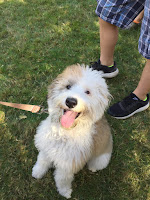
The Blessing of The Pets: Noah's Ark Extravaganza by Deb Farber

On Sunday, October 22nd, we gathered as a community at the home of Kris and Michael Goldberg to celebrate The Blessing of the Pets Noah’s Ark Extravangaza.


This was timely, as the Torah portion that week was about Noah.  The religious theme pervaded the day. The Rabbi, Cantor, and religious school students studied Torah and learned about how Judaism teaches us to care for animals.  The Rabbi and Cantor also offered a blessing for our pets, and said kaddish for pets we have lost.  There was also a fun craft project making rainbow arks run by some of our teens along with the chance to make misheberach cards and thank you cards. In the spirit of Tikkun Olam, we raised money and gathered donations for the Scituate animal shelter, whose representatives informed us about the animals waiting for “forever” homes.


We can’t wait to do this again next year!


Wednesday, November 8, 2017

Introducing Susan Kemen by Marylyn Schultz


A hearty welcome to Susan Kemen!  Susan is originally from Cincinnati, Ohio, received a degree in Middle Childhood Education (Math and Science, Grades 4-9) from Miami University in Oxford, Ohio, then attended a 2-year branch of University of Cincinnati to study chemistry before transferring to Northeastern University here in Boston to finish her degree in biochemistry.  Susan now lives in Quincy, working as a chemist for Haemonetics and drawing from her previous experience in quality control analysis and R&D for pharmaceutical companies.


Susan’s exposure to Judaism began in high school, when she sang the role of Chava in a local community production of “Fiddler On The Roof.” Her preparation for the role taught her enough to spark an interest. Exploring several different religions never offered a good match for Susan’s beliefs, that is until she found Judaism again as a young adult. Upon realizing that her values matched those of Judaism, Susan used Google to find reform synagogues on the South Shore, which led her to Sha’aray Shalom. Here she has found her religious home


Susan enjoys many interests, including scrapbooking, musicals and travel -- especially cruises. She is an avid “Star Trek” fan, and credits the show’s character Captain Kathryn Janeway for inspiring her own scientific pursuits.  Susan also loves to write, and published her first novel, Lioness, under the pen name Summer Jayne, 2011. Among her many hobbies is video production, which Susan first used to create digital scrapbooks but now uses to produce videos for Sha’aray Shalom’s very own YouTube channel.

Yom Kippur 2017 by Scott Garland

        Over the past year, I’ve been thinking a lot about eternity.  I don’t know whether that’s because I’ve hit my late 40s (and that’s about as late into your 40s that you could go), because both my kids have gone off to college, because my extended family has had several deaths, or because I assumed leadership of this community.  But my thoughts are filled with eternity. 
          Not, you should understand, eternity in the sense of worrying what will happen to my soul after I die.  G-d will take care of that.  Rather, eternity in two other senses, one outer, my effect on the world, and one inner, the world’s effect on me.  
The outer sense of eternity is how I can make what I do on Earth outlive me, if even for a short while.  I don’t create buildings or products or works of art that will outlive me.  I can cook a good meal, but that’s gone in an hour or two.  In fact, as a cook, any food that outlives me merely means that nobody wanted to eat it.
So how to make my work outlive me?  I have two answers:  my kids and my congregation.  If my kids are just a little more productive, more sociable, more compassionate, and more charitable than I have been myself, and if they carry these values forward, then my work will outli    ve me.
Those values don’t come from a void.  Those values come from our faith and are exemplified by this congregation.  And so, this congregation --- which greeted new families many years before mine, which educated children many years before mine, which helped the sick and the needy many years before I and my family could do the same, which counseled the concerned and comforted mourners many years before it did the same for me and my family --- this congregation should last to do the same for all the generations that follow.
And I intend to work just for the persistence of Judaism, but for the persistence of this congregation.  Because this place, this very building, matters.  It matters that Jews have a place, a physical place, to congregate on the South Shore.  It matters to draw Jews to the South Shore.  It matters to announce to our communities that we are here and a part of them.  It matters to have a place at which we can worship.  It matters to have a place at which we can educate our children.  It matters to have a place at which we can protect our ritual objects and conduct our rituals:  baby-namings, bar and bat mitzvahs, confirmations, weddings, and memorial services.  It matters to have a place with a preschool that educates not just our children, but also children from the larger, non-Jewish community, and thus sow greater tolerance.  It matters to have a place that employs clergy full-time to counsel us when we suffer or are bewildered, and to bring our families through all the challenges they face.  It matters to have a place at which we meet other Reform and interfaith families who become our friends and celebrate with us on holidays.
It matters that Congregation Sha’aray Shalom have a future.
Are we in danger of disappearing?  Not even close.  We have our own building, wonderful clergy, dedicated staff, a stable and perhaps slowly growing population, and relatively stable and perhaps slowly growing finances.  We are not only stable, but improving.  Having talked to other congregational presidents, I know that other congregations would envy our position.
Yet we face the same pressures that every other Jewish religious organization faces --- that in fact every religious organization faces, whether Jewish or not.  Our society is more secular:  people believe in and practice religion less and less.  They have many alternative places to fulfill their need for community:  their kids’ schools and sports teams, their places of business, the many secular charities, and even communities found online.  People feel like they have less time to devote to religious communities, whether because of long commutes, long working hours, always being online, busy children’s schedules, what have you.  Many activities and nonprofits compete for discretionary cash.  All these pressures are magnified by the fact that we are not a traditional neighborhood temple whose congregants all live within walking distance and work, shop, play and go to school together.  Instead, we live among a couple dozen towns and might see each other outside the temple little or not at all.
How can we overcome these pressures to ensure that this congregation outlives us all?
Most important, most important, most important of all:  we must do what I implored in my first speech as president:  “What if instead of being a member, you were a congregant?  A congregant is one who congregates, one who joins together with other people.  A congregant comes to a service with 200 other members and either talks to someone else --- even someone they don’t know --- or is approached by someone else.  A congregant joins others to learn about common issues.  A congregant joins others to do good works, like feeding the hungry or clothing the poor.  A congregant commits his resources to the congregation because the institution is bigger than himself and offers him a place to transcend himself.”
    A second way is to ensure that the congregation outlives us all is to never let you leave.  Like the mafia in The Godfather, just when you think that you’re out, we pull you back in.  Our leaders of the past continue to lead:  we have past presidents heading up our cemetery committee, our building committee, our caring committee, our nominating committee, and contributing their time and talent in many other ways.  I hope to do the same myself, once the congregation has another president.  And we don’t let congregants leave the flock easily.  Congregants who seek to leave out of concern that their financial contribution find that the congregation fiercely tries to take finances out of the question, and instead the congregation uses its own resources to ensure they stay with us.  As Rick Astley put it, “Never gonna give you up, never gonna let you down/Never gonna run around and desert you/Never gonna make you cry, never gonna say goodbye/Never gonna tell a lie and hurt you.”  If you are considering leaving the congregation because your resources are strained, I ask you --- I plead with you, I beg you --- do not be stiff-necked and disappear.  Instead, let our congregation adjust for you, just as you have adjusted for it.
    And I want to announce a new way to ensure that the congregation outlives us all, so that over the long term congregants can continue to join and participate fully in congregational life:  establishing an endowment.  Into this endowment, congregants can contribute, knowing that their contributions will not just supply next week’s bagels and lox, but instead will grow from generation to generation for our kids, our kids’ kids, our kids’ kids’ kids, and so on.  The L’Dor V’Dor Fund will generate income to lessen current financial pressures on congregants, with the principal safe from being spent except under specific procedures in times of dire, dire need.  This will be no quick fix.  Many contributions will come in through various flexible forms of long-term planned giving intended to honor congregants’ wishes to help future generations.  As you consider how your congregation can help your philanthropic priorities extend your reach into a future generation, please let us know how we can help.
    In contemplating eternity, I mentioned before, I’ve been thinking not only about how to make my work on Earth outlive me, but also about how the world can affect my soul for the good and for the rest of my life.  
The phrase “life-changing” is overused.  At a restaurant the other day, the waiter told me to order a molten chocolate cake for dessert because it was so good that it would change my life.  So good it would change my life?  How could I refuse?  So I ordered it and ate it.  It was very good.  In fact, very, very good.  But life-changing?  There was no burning bush, no parting of the waters, no voice from heaven.  No fantastic job offer, no winning lottery ticket, not even a drop in the humidity.  You call that a life-changing cake?
I am no expert on how to change my life forever.  But I do know that a good bet is to engage in experiences that are meaningful.  And by meaningful, I mean experiences that teach me, that change how I view the world, that bring me closer to other people.  A lot of moments here in temple do that.
This year, a unique and meaningful Jewish experience will present itself at our virtual doorstep in Boston, the Union for Reform Judaism’s 2017 Biennial Celebration.  From December 6th through December 10th, thousands of Jews from across North America and around the world will join together at the Hynes Convention Center to learn, pray, share ideas, dance and sing, hear from inspiring speakers and the leaders of our movement.
The biennial was last held in Boston in the early 2000s.  I attended with my family and with some of you here with us today.  It was the largest, most raucous service I have attended in my entire life.  What was it like?  Think about a moment during these high holidays when you’ve felt an upwelling in your heart or a chill up your spine.  For me, that’s when Rabbi tells an unexpected joke and we all break out in laughter together, when we sing “Sow in Tears” and “Yesh Kochavim”,  and when during T’kiah Gadola the shofar fills the room and lasts seemingly forever.  Have you felt a similar moment?  Can you feel it now?  Now multiply that feeling 500 hundred times, as you share it not just with all the people in this building, but with an entire city full of people engaged in study, song, and prayer.
We will have such moments at the biennial.  These experiences will be unique, and meaningful, and we will share them with each other.  We will carry them forward, individually and together, and see how we can use their spirit throughout our lives.  You have been receiving information on the biennial.  I beg you, for your own sake, to read it and register before the mid-October deadlines expire.  
Meanwhile, throughout this coming year, back at Congregation Sha’aray Shalom, we will offer such moments on a smaller scale but of no less beauty and meaning.  Dancing with the Torah on Simchat Torah.  Shaking the lulav on Sukkot.  Learning to chant Torah and Haftorah.  Doing good deeds for others.  Comforting those who are sick and who grieve.  Feeding the hungry.  And standing with the oppressed.  These moments, too, will change our lives.  
But only if we have open hearts, and only if we show up.
I look forward to a wonderful and sweet year with you.  Let’s work together to improve the rest of our lives and to make our work outlive us.
L’Shanah Tovah.

Take a Breath By Susan Kemen

Breathing.   A normal, healthy adult takes between 12 and 20 breaths per minute.   Assuming the average breathing rate is 16 breaths per...